← Work

AI-powered manufacturing forecasting platform

Role

Product UI/UX Designer

Stage

Pre-Seed → Seed → Series A

Year

2021 – 2022

Sector

Industrial AI · Predictive Reliability

Case studyEnterprise AIIndustrial AI
AI-powered manufacturing forecasting platform — hero image
(001)

The Problem

" Product failures don't arrive as surprises. They arrive as ignored signals. The signals are there. The problem is that nobody has connected them yet. "

Warranty claims. Service technician notes. Supplier quality reports. Assembly line logs. In manufacturing, the early warning signs of a reliability crisis are almost always present — scattered across disconnected systems, weeks or months before anyone connects them. By the time a failure reaches recall threshold, the window to act cheaply has long closed. The damage — field repairs, regulatory scrutiny, reputational cost — has already compounded. AI can monitor fragmented reliability signals continuously and surface anomalies to engineers before they become crises.
(002)

User research

Reliability engineers need to justify every decision to their team. Before designing anything, I needed to understand how they investigate failures, where existing tools break down, and what makes an AI recommendation worth trusting.

Personality Traits

CreativityCollaborative spirit, embraces feedbackWork-life balance adept to collaborationCritical thinkingDirect, open & honestCuriosity

Manufacturing reliability engineers are trained skeptics.

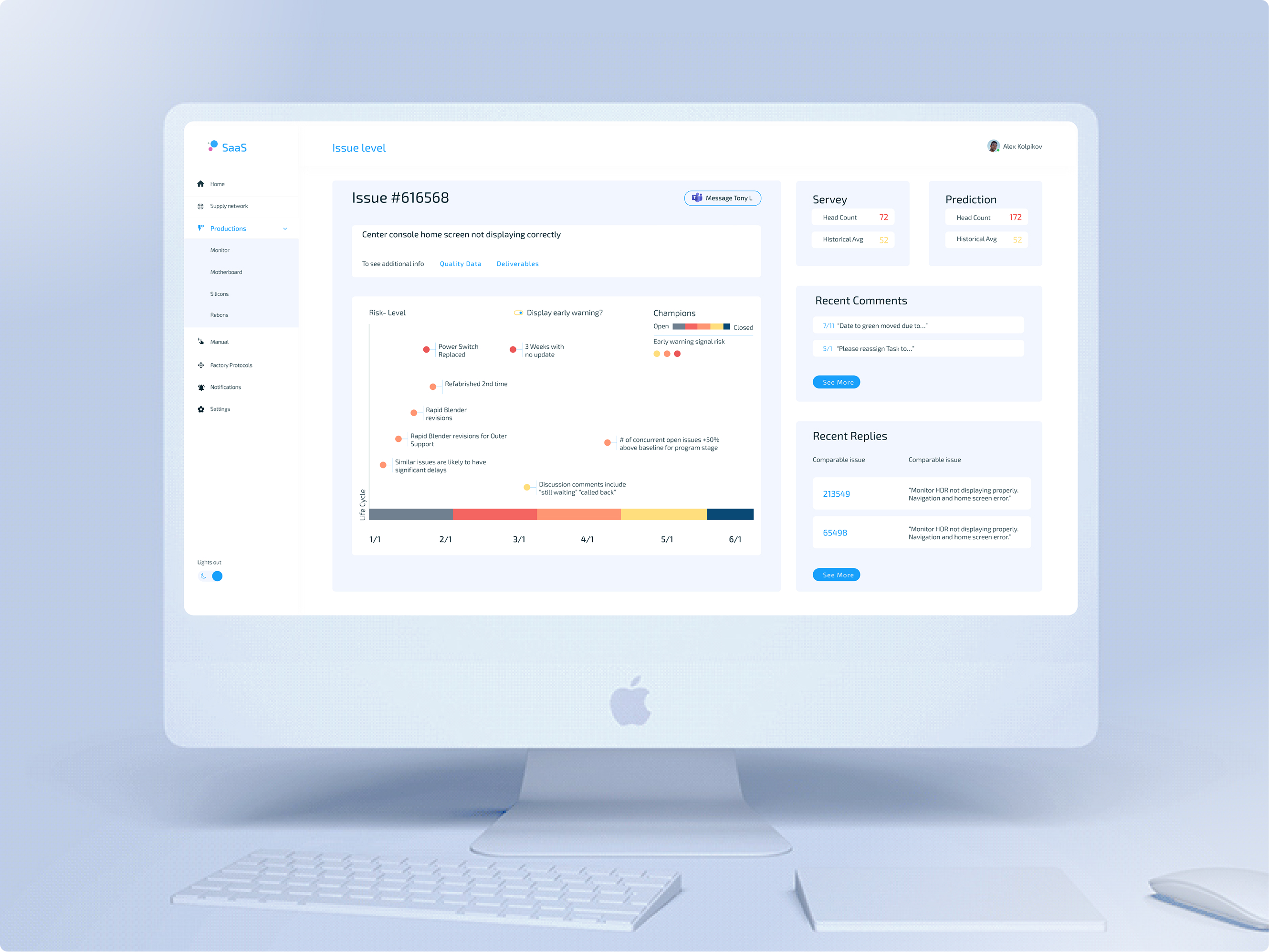
A dashboard that simply said "anomaly detected" would be ignored. A system that shows WHY something is unusual, WHAT signals contributed, and HOW confident the AI is — earns investigation

All UX decisions in this phase focused on interpretability and investigation.

Challenges & Pains

Visibility into program, progress statusLimited engineering input to process improvements.Limited visibility in engineering team accomplishmentsAlignment of engineering vs cost/timingAnecdotal feedback from engineering dept for improvementAccurate visibility into program/project metricsDeadline & engineering activities incompatibilitiesTiming pressure

Existing Systems Causes:

AnxietyHelplessnessFrustratedUnsure / Overwhelmed

Have to Bring In These Emotions:

ExcitementInspirationPride
(003)

Key design decisions

Interpretability over abstraction

Chose

Every anomaly card shows WHY the AI flagged it, WHAT signals contributed, and HOW confident the model is — rather than just surfacing an alert.

Why

Manufacturing engineers are trained to dismiss signals they can't audit. A system that presents conclusions without showing its reasoning gets treated as noise.

Tradeoff

Each anomaly card carries significantly more visual weight. Resolved with progressive disclosure: summary view for scanning, expanded view for investigation.

Layered drill-down over single-screen density

Chose

Every anomaly card shows WHY the AI flagged it, WHAT signals contributed, and HOW confident the model is — rather than just surfacing an alert.

Why

Manufacturing engineers are trained to dismiss signals they can't audit. A system that presents conclusions without showing its reasoning gets treated as noise.

Tradeoff

Each anomaly card carries significantly more visual weight. Resolved with progressive disclosure: summary view for scanning, expanded view for investigation.

Consistent visual encoding over per-chart flexibility

Chose

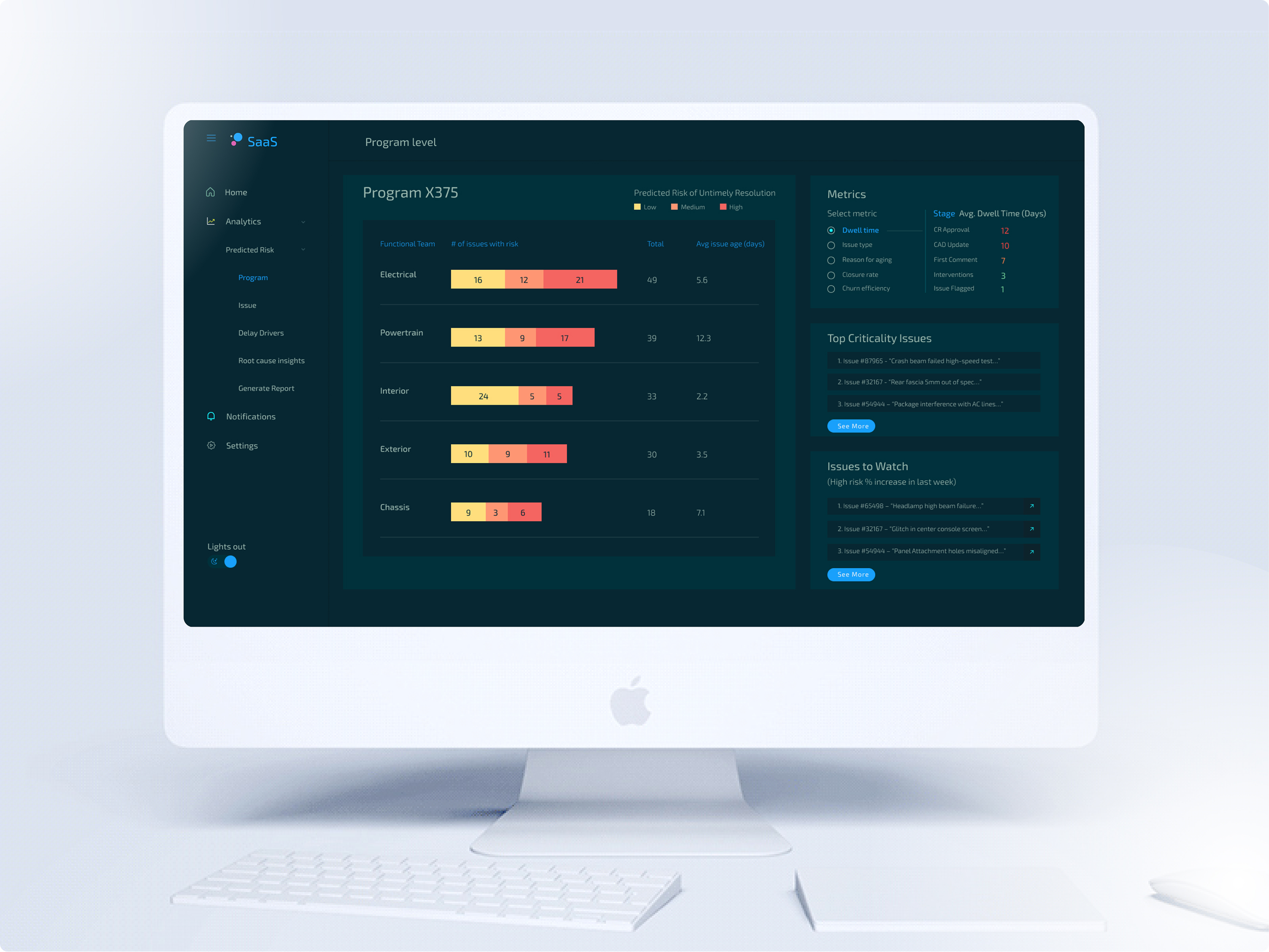
A unified chart grammar where the same visual treatment — colour, density, axis scale — means the same thing across all five data source types.

Why

Engineers rotate between data sources. Inconsistent visual encoding creates cognitive overhead and misinterpretation risk. A shared grammar removes that tax.

Tradeoff

Some data types don't map perfectly to the standard encoding. We accepted minor visual precision trade-offs to preserve system-wide legibility.

(004)

Solution structure

Five data sources. One intelligence layer.

Warranty claims

Structured field failure data — the clearest signal, but always lagging.

Service reports

Technician observations — unstructured but rich with early warning insight.

Manufacturing logs

Assembly line process deviations and quality checkpoints.

Engineering feedback

Internal reliability assessments from engineering teams.

Supplier data

Component quality metrics and inspection reports.

From signal to root cause.
End-to-end experience

01

AI detects anomaly

02

Signal surfaces in reliability dashboard

03

Engineer opens anomaly insight panel

04

Trend visualization shows deviation

05

Engineer filters master dataset

06

Component-level root cause investigation

Data flow

Manufacturing data sources

AI processing layer

pattern detection · anomaly scoring

Insight layer

anomaly alerts · signal trends

Engineer investigation workspace

dashboards · charts · master tables

(005)
Phase 01 · Pre-seed · 2021

Building the foundation. Sole designer. Zero to investor-ready.

When I joined, the company had a thesis, a technical team, and an urgent need: build something real enough to show investors this idea could become a product. I was the sole designer. No design system. No component library. No product interface to extend. I had to design interfaces that demonstrated the platform's analytical potential clearly enough to convince investors — while also being structurally sound enough to actually build.

Key Work

Dashboard architecture

Chart visualization patterns

Early reliability insight layouts

Analytical interface structure

Series outcome

$7.5M seed raise — February 2023

Investors: Boeing · Amplo · Inspired Capital

Building the foundation. Sole designer. Zero to investor-ready. — phase image
(006)
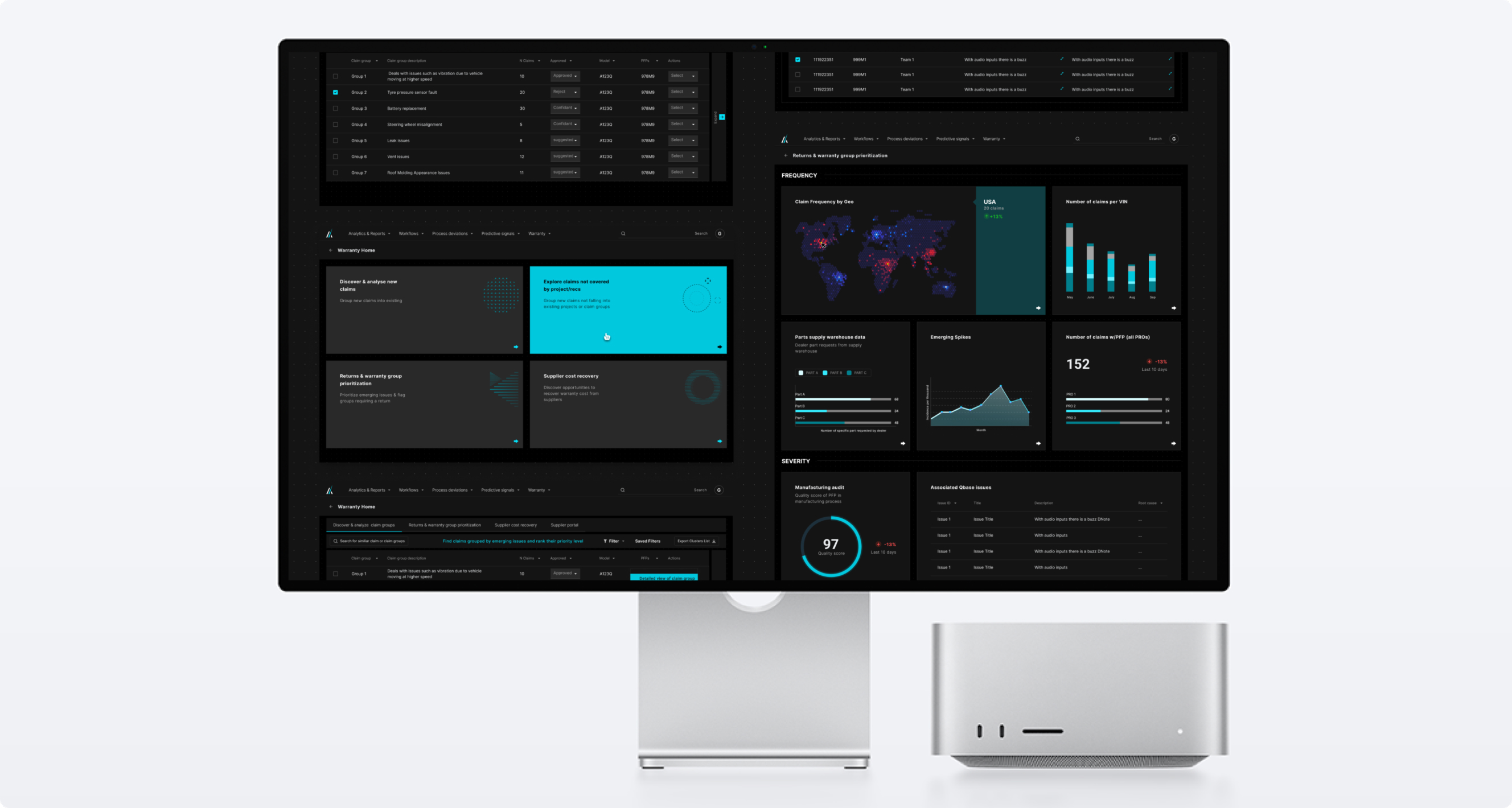
Phase 02 · Seed stage · 2021 – 2022

Designing for engineers who don't trust what they can't audit.

AI insight interface

  • Anomaly alerts
  • Signal confidence indicators
  • Deviation highlights against historical baselines
  • Interpretable insight summaries

Engineers could see what changed, how unusual it was, and why the system flagged it.

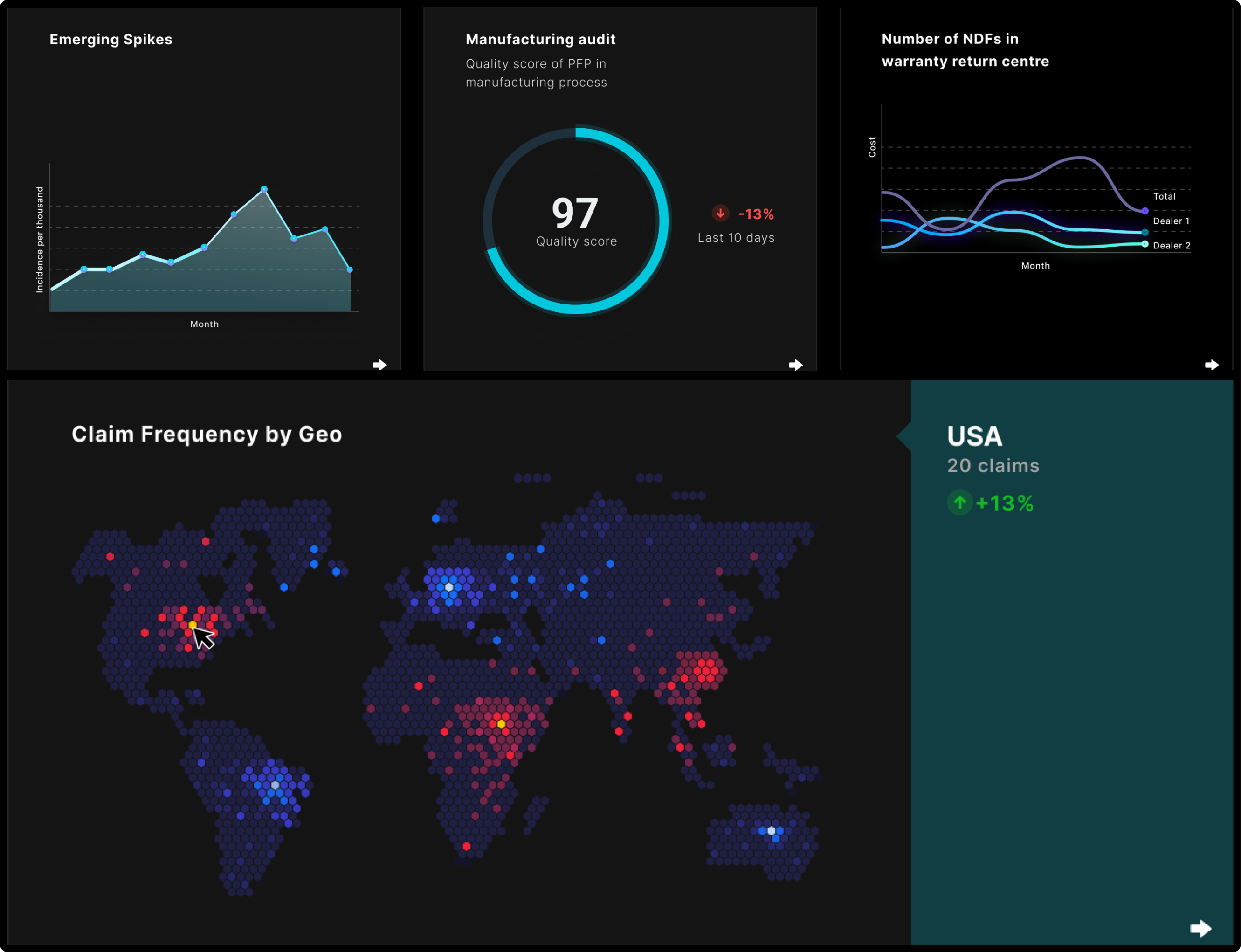
Data visualization system

  • Trend charts
  • Anomaly score graphs
  • Comparative component analysis
  • Reliability signal overlays

Helped engineers interpret patterns quickly across millions of records.

Enterprise data tables

  • Multi-dimensional filtering
  • Configurable column views
  • Anomaly-score sorting
  • Expandable row inspection

These tables became the most-used workspace for reliability investigation.

Designing for engineers who don't trust what they can't audit. — phase image

(007)

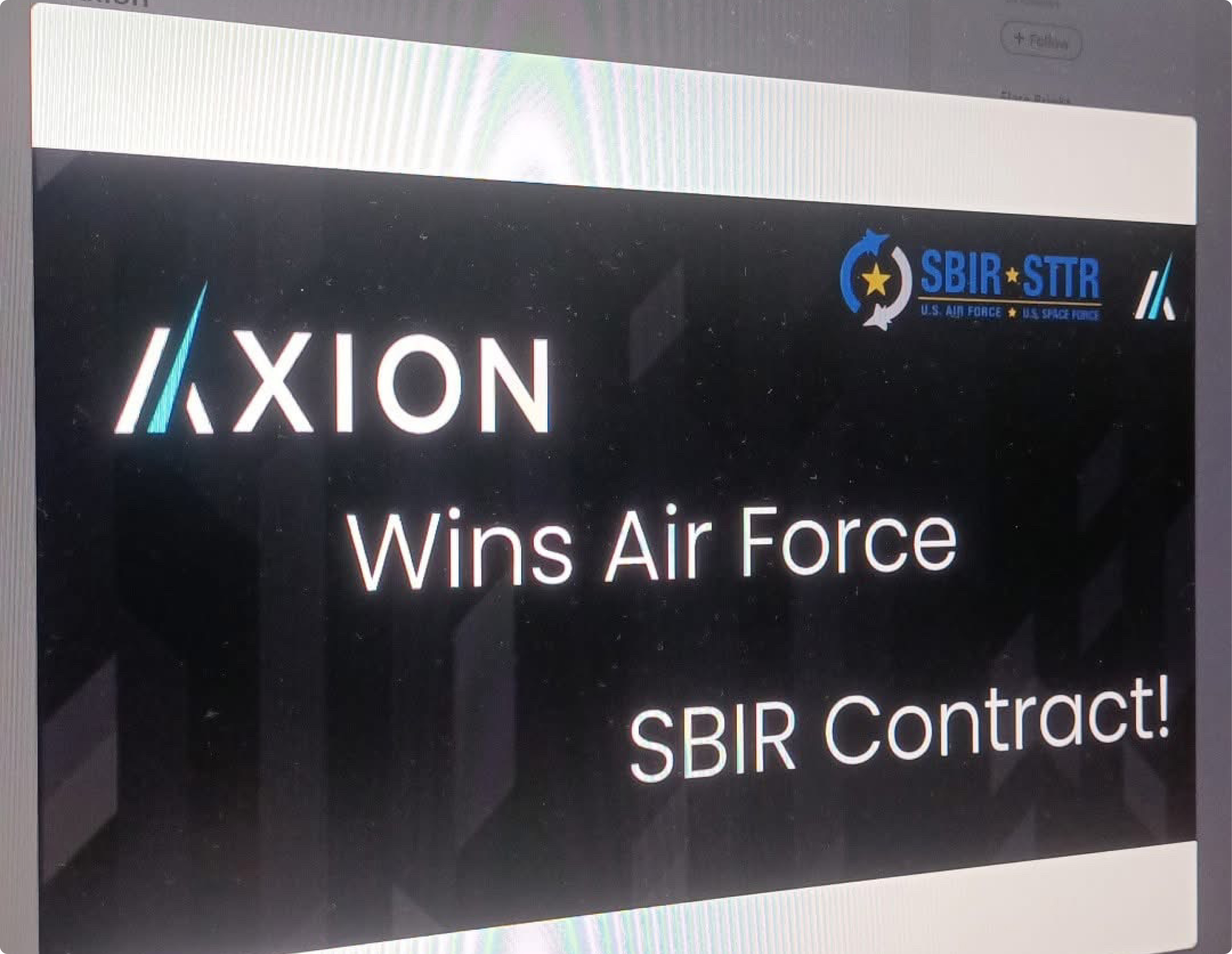
Milestone · U.S. Air Force SBIR Contract

Defense-grade reliability intelligence.

During the Series A stage, the platform secured a U.S. Air Force SBIR contract. This validated both the AI technology and the product's operational readiness. Design work contributed to presenting AI-driven reliability insights clearly enough for government and defense evaluation contexts. Every label, chart axis and confidence indicator needed to stand up to scrutiny.

U.S. Air Force SBIR Contract — Axion Ray milestone
(008)
Phase 03 · Post Series A · 2022

From sole designer to scaling an enterprise platform.

Following Series A funding, the product team expanded. I transitioned from sole designer to part of a three-person design team alongside a Senior UX Designer and Acting Art Director. The design focus shifted from invention to scale.

Investigation workflow refinement

Reducing friction between anomaly alerts and root-cause analysis.

Data interface scaling

Supporting larger datasets and more complex filtering scenarios.

Design system growth

Contributing new chart and table components and aligning the platform's UI patterns.

Enterprise collaboration

Working across product and engineering to scale design systems and investigation workflows for an enterprise-grade platform.

Series A outcome

$17.5M Series A — March 2024, total raised: $25M

Led by Bessemer Venture Partners, strategic investment from RTX Ventures (Raytheon)

From sole designer to scaling an enterprise platform. — dashboard panels
From sole designer to scaling an enterprise platform. — phase image
(009)

Outcome: A platform engineers trust. A product investors backed.

$7.5M

Seed round

$17.5M

Series A

$25M

Total raised

SBIR

U.S. Air Force contract

The platform raised $25M across three stages, backed by strategic investors including Boeing, Denso, Baxter, and Raytheon — validating AI-driven reliability intelligence for manufacturing at scale.

Skills Applied

Enterprise product design
AI interface design
Data visualization systems
Investigative workflow UX
Design systems
Startup product scaling

Interfaces shown are illustrative reconstructions.

(010)

Reflections of two years. Three funding stages.

01

Domain depth improves design decisions.

Understanding reliability engineering workflows changed how interfaces were structured.

02

AI interfaces require transparency.

Confidence indicators and interpretability are essential for user trust.

03

Design systems are infrastructure.

Consistent visual encoding is essential for complex analytical products.

Client feedback

"It was a true pleasure working with Fazlul. His designs are highly professional, expert, and aesthetically sophisticated."

"Fazlul is the best designer you could ever ask for. Dedicated, respectful, and a creative genius."

"Fazlul is the most talented designer I have ever worked with."

Daniel First, CEO